Walk into most dental labs and you’ll find a shelf of resin bottles from five different brands — one for models, another for guides, a third for temps — each with its own printer profiles, wash protocols, and cure times. It works, but it’s inventory chaos.
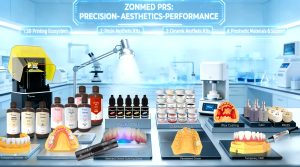
There’s a simpler way to think about it: map your materials to your workflow. Below is every resin a digital lab needs from intraoral scan to final seating, organized by production stage — all available as one compatible 18-resin system, finished with two matching stain kits.
Stage 1: Models and planning
Every case starts with a model. Different cases need different model properties:
- R-15 Water Washable Model — the everyday workhorse. Rinses under tap water (no solvent wash station needed), keeping entry-level model production fast and clean.
- R-16 Opposite Jaw Model — boil-resistant with no release agent required. Built for articulation and occlusal analysis that survives hot-water workflows.
- R-17 Orthodontic Model — heat-resistant to 185°C for aligner thermoforming, ultra-low viscosity for crisp detail. The model behind clear aligner film production and bracket positioning.
- R-18 Planting Model — high-precision implant surgery models with segmented die compatibility.
- R-03 Try-In — single-use try-in bridges for previewing restorative outcomes and adjusting occlusion chairside.
Stage 2: Surgical guides
- R-11 Surgical Guide — transparent resin for implant and orthodontic surgical guides, engineered for precise drill-path transfer from plan to patient.
Stage 3: Orthodontics
- R-09 IBT — indirect bonding trays for bracket and attachment placement, printed in segments.
- R-10 Tray — orthodontic and impression trays with accurate positioning.
- R-13 Night Guard Pad — transparent blue, heat-activated for shaping; night guards and occlusal splints.
- R-14 Clear Aligner — the flagship: directly 3D-printed clear aligners with progressive force delivery for adult orthodontics. Transparent, flexible-base, and engineered to cure in a standard unit in 3–5 minutes with no yellowing — no nitrogen chamber required.
Stage 4: Restorative — crowns, veneers, and temps
- R-01 Permanent Crown — the definitive restoration resin: flexural strength 180–208 MPa, ceramic-filled options, VITA shades BL through C1. The printed alternative to traditional metal-ceramic crowns.
- R-02 Temporary C&B — temporary crowns and bridges for the critical healing window after preparation or endodontics.
- R-06 Temporary Veneer — ultra-thin, high-translucency provisionals for short-term try-ins and whitening-phase protection.
- R-07 Smile Veneer — no-prep removable aesthetic veneers with 92% elongation at break; everyday smile aesthetics without touching the tooth.
Stage 5: Removable prosthetics
- R-04 Flexible Base — elastic denture base (75–95% elongation) for sensitive gums and resorbed ridges.
- R-05 Full Mouth Movable Base — full-denture bases with 142 MPa flexural strength.
- R-12 Biomimetic Gum — 200–320% elongation silicone-like gingiva for implant surgery simulation and denture aesthetic design.
Stage 6: Casting patterns
- R-08 Wax Casting — clean burnout with under 0.15% ash residue; casting patterns for metal frameworks, PFM crowns, and ceramic castings. The digital replacement for hand-carved wax.
Stage 7: Finishing — the stain systems
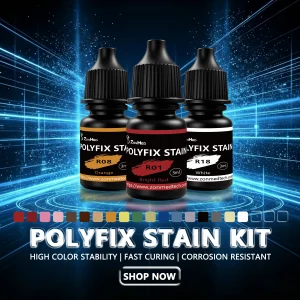
- Polyfix (PRS-S-R) — 18 colors plus diluent and two glazes, light-cured in 30 seconds. For everything resin and polymer: printed dentures, provisionals, PEEK frameworks.
- Ceramix (PRS-S-G) — 20 shades (G01–G20) for external staining of zirconia, glass ceramics, and cast ceramics, fired in the normal furnace cycle.
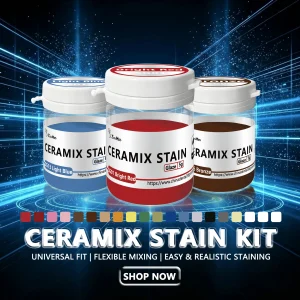
Zonmed Ceramix low-temperature glaze paste for natural fluorescence and high gloss.
Full comparison: Polyfix vs Ceramix — which system does your lab need?
Why one system matters
Eighteen resins from one manufacturer means one set of printer profiles, one wash-and-cure logic, one supplier relationship, and one support line. When a case moves from model (R-17) to aligner (R-14) to stained finish (Polyfix), nothing gets lost in translation between brands.
For labs standardizing their digital workflow — or distributors building a resin portfolio — the complete list above is the entire materials shelf, from scan to seat.
Related reading:
- All 18 PRS print resins
- R-01 Permanent Crown Resin
- Polyfix Stain Kit
- Do printed aligners need nitrogen curing?
Building or standardizing your lab’s resin shelf? Browse the full 18-resin system or talk to our team about distributor partnerships.
2 回复