
Clinical Case Study & Technical Guide: 3D Printed Permanent Composite Crowns and Dental Material Science White Paper
Technical Guide · Product: Zonmed PRS-R-01 Permanent Crown Resin
1. Introduction: The Paradigm Shift in Digital Permanent Restorations
Additive manufacturing in dentistry has long evolved far beyond diagnostic models and temporary splints. Today, clinical demand for durable, long-lasting permanent restorations—specifically single crowns and inlays—requires materials that bridge the gap between traditional ceramics and high-performance polymers.
Traditional subtractive milling (CAD/CAM ceramic blocks) has historically faced persistent pain points, including material waste, geometric undercut limitations, and rapid bur wear.
Conversely, many cheap 3d printed permanent crown resin alternatives on the market lack the mechanical strength required for posterior masticatory loads. To overcome this bottleneck, integrating high-density submicron inorganic ceramic reinforcements into specialized Interpenetrating Polymer Networks (IPN) has redefined permanent crown 3D printing technology. This technical white paper evaluates the material chemistry, photopolymerization kinetics, and clinical processing parameters of the Zonmed PRS-R-01 Permanent Crown Resin ecosystem.
2. Material Chemistry: 60% Nano-Ceramic Integration, Micro-Morphology, and Industry Raw Material Realities
In posterior dental restorations, mechanical failure typically originates from micro-crack propagation under cyclic fatigue. Pure photopolymer resins inherently suffer from insufficient flexural strength and high volumetric shrinkage.
Dual-Specification Ceramic Filling Strategy
Zonmed PRS-R-01 utilizes an engineered formulation framework. Specification 1 introduces an experimentally validated 60% inorganic ceramic filler loading, creating an exceptionally dense matrix designed for high-load posterior regions; Specification 2 is engineered for multi-layer aesthetic transitions.
Micro-Morphology of Barium Glass and Aesthetic Dilemmas (Spherical vs. Irregular Fillers)
When sourcing high-grade barium glass nanoparticles, the micro-morphology of the filler particles (spherical versus irregular) critically dictates rheological behavior, light-scattering efficiency, and ultimate mechanical packing density. Low-cost resins often rely on cheap, inferior fillers due to budget constraints, resulting in printed restorations that look flat, opaque, and “chalky white”—entirely failing to match the natural opalescence and translucency of human teeth. Zonmed meticulously controls the golden ratio of spherical to specialized morphology fillers, optimizing flowability and high mechanical strength while delivering natural, warm optical aesthetics.
Raw Material Costs and Industry Realities: Why Cheap Permanent Crown Resins Fail
The dental 3D printing market is flooded with low-cost “permanent crown” resins (often repackaged model or temporary crown resins). These cheap alternatives never invest in genuine R&D validation:
- The Micro-Sized Filler Trap (No Strength, No Radiopacity): Many low-cost resins utilize cheap, coarse micro-sized zirconia or glass fillers. Due to poor particle size distribution and a complete lack of interfacial chemical bonding, these formulations offer zero real mechanical reinforcement and virtually zero effective radiopacity—meaning clinicians cannot detect marginal gaps or secondary caries via dental X-rays, posing severe clinical risks.
- Severe Sedimentation Disasters: Inferior resins often suffer from severe particle agglomeration and hard caking after sitting for just half a day. Lacking advanced submicron surface modification, fillers segregate mid-print, leaving parts with isolated pockets of pure resin and brittle clusters, leading to total structural failure.
- The Cost Barrier of Premium Barium Glass Nanoparticles: True dental-grade barium glass nanoparticles capable of providing perfect radiopacity and refractive index matching cost upwards of $400+ per kilogram. Budget resins cut corners right at the raw material stage, forcing them to use industrial-grade fillers.
R&D Evolution: The Rigorous 50–60 Iteration Closed-Loop Testing Protocol
True source manufacturing is never left to chance. To lock in the 60% golden filler ratio and flawless optical texture, the Zonmed R&D team established a rigorous closed-loop testing protocol spanning 50 to 60 strict iterations:
- 10-Printer Cross-Validation: Following each formula adjustment, the team simultaneously deployed 10 mainstream 3D printer brands utilizing 385nm dental 3D printers to evaluate process stability across varying light intensities and peeling forces.
- Physicochemical & Wear Testing: Standardized testing strictly measured flexural strength (180–208 MPa), Shore D hardness (90–96), and dynamic chewing wear resistance.
- Biocompatibility Baselines: Submitted to certified independent third-party laboratories for cytotoxicity and oral mucosa irritation assays to ensure minimal residual monomer elution.
- CBCT Imaging Validation: Printed crowns bonded to standard models underwent 3D CBCT scans to confirm that premium barium glass nanoparticles provide sharp radiopacity contrast, eliminating traditional diagnostic blind spots.
- Oral Masticatory Simulation: Subjected to thousands of thermal cycles and dynamic mechanical fatigue simulations to guarantee ultimate mass-production reliability.
Interfacial Silanization and Long-Term Hydrolytic Aging Stability
Surface-modified ceramic particles are treated with specialized silanizing coupling agents, forming covalent bonds during polymerization. This yields a remarkable 180–208 MPa flexural strength (ASTM D790), 7000–8800 MPa flexural modulus (Specification 1), and an optimal 90–96 Shore D hardness.
Accelerated Hydrolytic Aging Verification: In accelerated hydrolytic aging simulations equivalent to 5 years of clinical service, Zonmed PRS-R-01 maintained over 95% of its initial flexural strength, exhibiting outstanding resistance to water degradation and fatigue.
Clinical Longevity Disclaimer: Please note that due to individual patient variations (such as bite force magnitude, bruxism habits, oral hygiene, and daily maintenance), actual clinical service life will vary.
3. Photopolymerization Kinetics: Why 385nm Wavelength is Non-Negotiable
A frequent point of failure in 3D-printed dental medical devices is incomplete monomer conversion, leading to residual monomer cytotoxicity and long-term hydrolytic degradation.
The Light-Scattering Challenge: When a resin is heavily loaded with 60% ceramic fillers, light scattering increases exponentially. Traditional 405nm printers struggle to penetrate dense ceramic-resin suspensions, resulting in unpolymerized core zones.
385nm UV Spectral Efficiency: Zonmed PRS-R-01 is engineered specifically for 385nm UV light sources. The 385nm wavelength perfectly aligns with the absorption spectrum of our proprietary photoinitiator system, minimizing photon scattering, achieving deeper Z-axis photon penetration, driving higher double-bond conversion rates, and reducing residual monomer leaching to absolute minimums.
4. Clinical Case Presentation: Posterior Tooth Restoration
Case Background: A patient presented with severe posterior tooth structure loss and compromised occlusal integrity, requiring a durable, biocompatible, and aesthetic single crown restoration.
Material Selection: Zonmed PRS-R-01 Permanent Crown Resin (Specification 1: 0.25kg/bottle, containing 60% ceramic fillers and premium barium glass nanoparticles) was chosen to maximize density, marginal stability, and mechanical resilience.
Visual Clinical Evidence
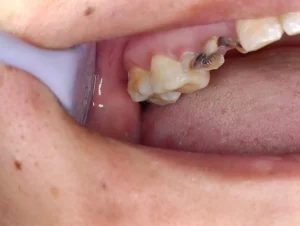
- Figure 1 (Initial Assessment): Initial presentation of the compromised posterior tooth requiring a permanent crown.
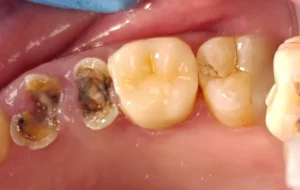
- Figure 2 (Post-Print Seating & Marginal Check): High-precision marginal adaptation and smooth occlusal morphology immediately following post-processing.
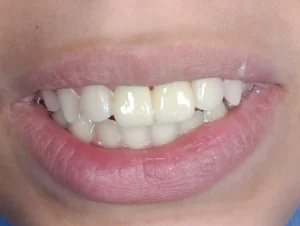
- Figure 3 (Final Aesthetic Integration): Final intraoral seating demonstrating natural shade transitions (Bl, A1, A2, A3) and harmonious gingival response.
5. Technical Performance Reference Specifications
| Parameter | Standard | Unit | Result |
|---|---|---|---|
| Shore Hardness | ASTM D2240 | Shore D | 90–96 |
| Flexural Strength | ASTM D790 | MPa | 180–208 |
| Flexural Modulus (Spec 1) | ASTM D790 | MPa | 7000–8800 |
| Flexural Modulus (Spec 2) | ASTM D790 | MPa | 4300–4700 |
| Density (Specification 1) | / | g/cm³ | 1.6–1.7 |
| Notched Impact Strength | ASTM D256 | MPa | 18–28 |
| Elongation at Break | ASTM D638 | % | 4–6.5 |
| Water Sorption | ASTM D570 | % | 0.35–0.42 |
| Tensile Strength | ASTM D256 | MPa | 85–90 |
6. Standardized Laboratory Workflow & Critical Pitfalls to Avoid
Data Preparation & Slicing: Import the crown STL file into slicing software, setting recommended support density and orientation to protect marginal ridges.
Resin Mixing: Thoroughly shake the Zonmed PRS-R-01 bottle to ensure uniform distribution of the 60% ceramic suspension. Maintain printing environment temperatures between 68°F–86°F (20°C–30°C).
Cleaning Protocol & Critical Anti-Whitening Warning
⚠️ Major Laboratory Warning (Strictly No Ultrasonic Baths, No Industrial Alcohol): Due to the 60% ceramic filler loading in Specification 1, never submerge permanent crowns in solvents or clean them in an ultrasonic bath. Doing so damages the silane interface, causing severe surface whitening, hazing, and chalky discoloration, while industrial alcohol leaves toxic chemical residues.
Correct Operational Practice (Targeted Medical Ethanol Cotton Swab Wiping): You must use a cotton swab moistened exclusively with medical-grade ethanol (or high-purity 95% pharmaceutical isopropyl/ethyl alcohol) to gently spot-wipe and clean uncured surface residues. Immediately blow dry with compressed air to ensure the surface remains completely dry and maintains brilliant gloss.
Heat-Assisted Post-Curing Stage
Carefully remove support structures. To achieve maximum monomer conversion, eliminate internal stress, and unlock the full 180–208 MPa flexural strength, place the restoration into a professional post-curing unit equipped with synchronized heating (optimal temperature range: 40°C–60°C) and high-intensity curing power (3000–5000 mW/cm²) for 5–10 minutes.
Aesthetic Customization and Long-Term Protection via Dedicated PolyFix Resin Stains & Glaze Systems
Solving “Chalky White” Issues & Achieving Ultimate Aesthetics: To address monochromatic limitations or lack of translucency in base crowns, this material fully supports integration with the matching PolyFix Resin Stain and Glaze System. Through personalized characterization staining and glazing, it perfectly simulates natural tooth shade gradients, fluorescence, and opalescence, completely eliminating the “plastic, chalky” look typical of traditional resin crowns.
Antibacterial Shielding, Microleakage Prevention & Extended Lifespan: The glaze layer seals microscopic surface pores, maintaining water absorption at an ultra-low 0.35–0.42% to permanently block hydrolytic aging. Simultaneously, the smooth high-gloss surface significantly minimizes plaque accumulation and secondary caries risks, creating an occlusal stress buffer shield that substantially extends the overall clinical longevity of the permanent crown in the oral cavity.